
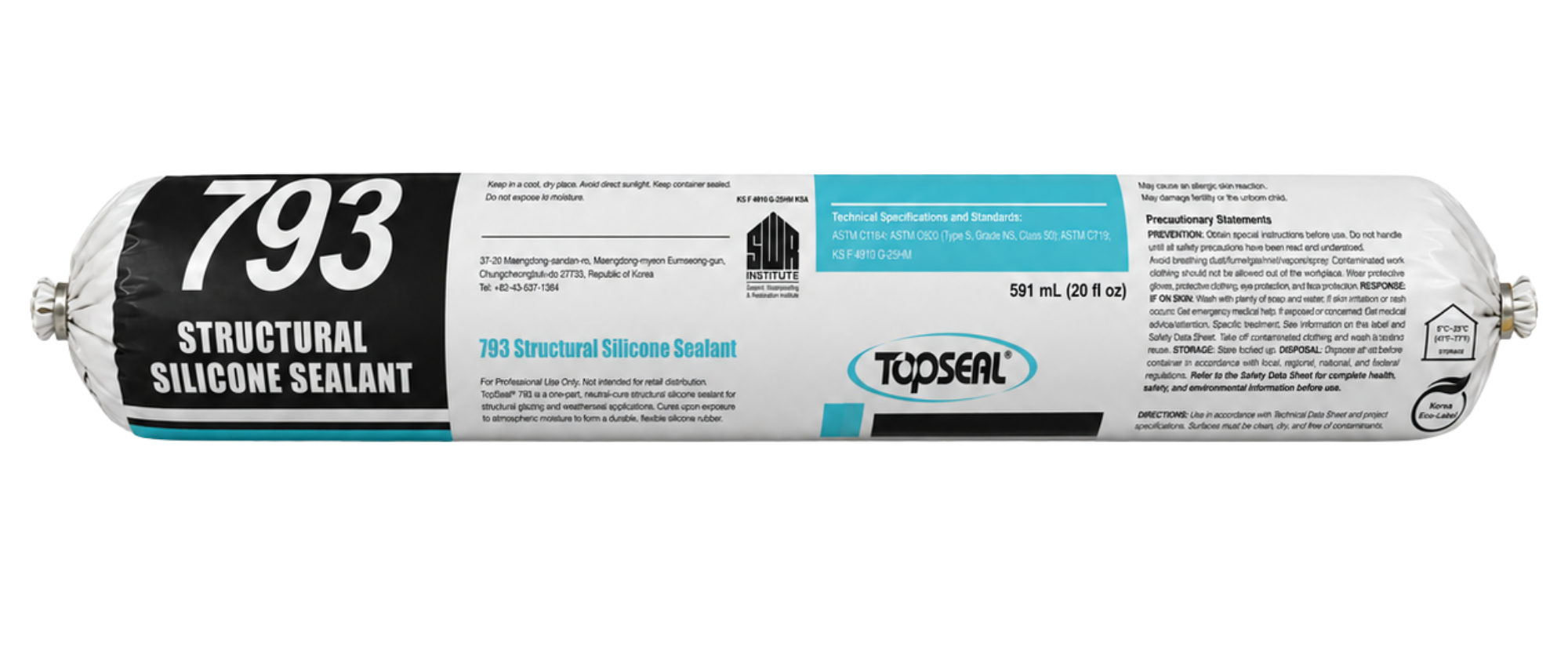
Manufacturer: TopSeal Co., Ltd.

TopSeal® 793 is designed for structural glazing and high-performance weatherseal applications across modern façade systems:
20 fl.oz. (591 ml) sausage
White, Black, Anodized Aluminum, Bronze, Charcoal, Gray, Champagne. (Inquire about custom colors.)
43 (avg)
ASTM C661
92–133 psi (various conditions)
ASTM C1135
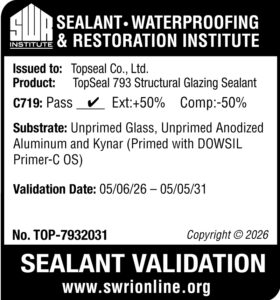
± 50%
ASTM C719
Excellent - No cracking after accelerated weathering; strong post-weathering tensile adhesion
ASTM C793
-26°F to 176°F (-32°C to 80°C)
100-123 N average depending on substrate
ASTM C794
No observable stain or discoloration on mortar; no sealant color change observed
ASTM C510 (QUV exposure)
No sag / no deformation
ASTM C639
Tack Free Time
~3 hours
Cure Time
7–14 days
Full Adhesion
7–14 days
20–30 minutes
77 °F (25 °C) 50 % RH
20 oz (591 ml) Sausage
Theoretical yield based on joint dimensions. Actual yield may vary depending on substrate conditions, tooling, and waste.
Substrates must be clean, dry, sound, and free of frost, dust, dirt, oils, greases, curing compounds, or any contaminants that may interfere with adhesion. All surfaces should be prepared in accordance with project specifications and ASTM C1193 guidelines.
POROUS SUBSTRATES – Clean by mechanical methods such as grinding, sanding, or wire brushing to remove loose particles, laitance, and surface contamination, exposing a sound substrate.
NON-POROUS SUBSTRATES – Clean using the two-cloth wipe method with isopropyl alcohol, xylene, or an approved solvent. Wipe with a clean cloth before the solvent evaporates to remove contaminants. Allow surfaces to dry completely prior to sealant application.
TopSeal® 793 is designed to achieve adhesion to many common construction substrates without the use of a primer; however, primer may be required depending on the substrate and project conditions.
Adhesion and compatibility testing should be performed prior to application to determine whether priming is necessary. Where required, primer selection and application shall be based on TopSeal recommendations and project-specific testing.
For structural glazing applications, all substrates must be reviewed and approved through project-specific adhesion and compatibility testing in accordance with ASTM C1193.